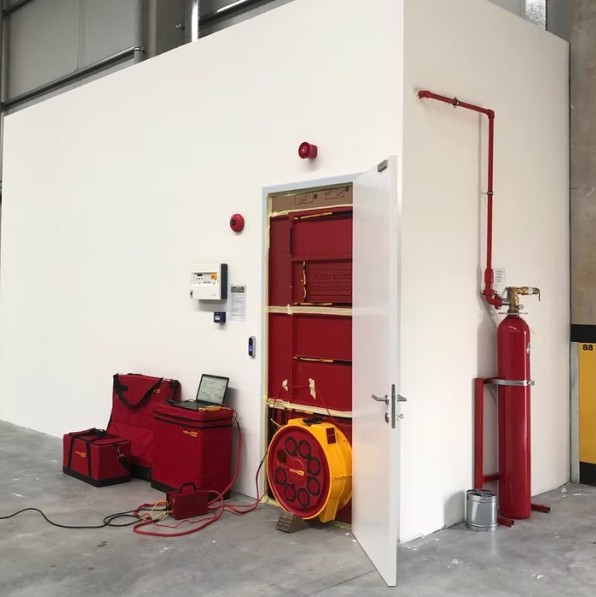
Room Integrity Testing for gaseous fire suppression systems is a critical verification service that ensures enclosed spaces (like server rooms, data centers, control rooms, or industrial enclosures) can effectively retain clean agent concentrations long enough to fully suppress and prevent re-ignition of fires.
Room Integrity for Gaseous Fire Suppression Systems
Description
Room Integrity Testing for gaseous fire suppression systems is a critical verification service that ensures enclosed spaces (like server rooms, data centers, control rooms, or industrial enclosures) can effectively retain clean agent concentrations long enough to fully suppress and prevent re-ignition of fires.
Also known as the Door Fan Test or Enclosure Integrity Test, this non-destructive procedure measures the airtightness of the protected room by quantifying leakage paths. Using specialized blower door fans temporarily sealed in a doorway, technicians pressurize and depressurize the enclosure to record airflow and pressure differentials. Data is input into software (per NFPA 2001 Annex C guidelines) to calculate the Equivalent Leakage Area (ELA) and predict the agent hold time—ensuring the gaseous suppressant (e.g., from Fike ECARO-25, FM-200, Novec 1230 equivalents, or inert gases) maintains at least 85% of the adjusted minimum design concentration at the highest combustible level for a minimum of 10 minutes (or longer for some agents like CO2).
This test is mandatory under NFPA 2001 (Standard on Clean Agent Fire Extinguishing Systems) for system acceptance, commissioning, and periodic recertification—often annually or after modifications—to comply with codes, insurance requirements, and maintain system reliability. Poor integrity (e.g., unsealed penetrations, gaps around doors/windows/cables, or HVAC leaks) can cause rapid agent loss, leading to fire reflash, increased damage, and system failure.
We offer professional Room Integrity Testing services as part of our comprehensive fire protection solutions, including sealing recommendations and repairs to achieve compliance.
Key Benefits
Ensures system effectiveness — Confirms the enclosure will hold the gaseous agent long enough to extinguish fires and prevent re-ignition, maximizing protection for high-value assets.
Code & insurance compliance — Meets NFPA 2001 requirements; satisfies FM Global, UL, local AHJs, and insurer mandates for clean agent systems.
Non-destructive & predictive — Uses safe fan testing (no actual agent discharge needed); accurately models real-world performance without risk.
Identifies & fixes issues early — Pinpoints leaks (e.g., cable trays, conduits, joints, doors) for targeted sealing, improving overall enclosure integrity and reducing future costs.
Periodic verification — Recommended annually or after facility changes (renovations, new penetrations) to maintain ongoing reliability.
Seamless integration — Complements gaseous systems like Fike ECARO-25, pairs with Potter fire alarm panels for detection/release coordination, and Starlink 24-hour monitoring for reliable alerting.
Cost-effective assurance — Prevents costly failures, downtime, or rework; often required before final system handover.
Ideal for facilities using total flooding gaseous suppression (clean agents or inert gases) in critical environments such as data centers, telecom rooms, electrical switchgear, museums/archives, or manufacturing control areas—where business continuity and asset protection depend on reliable fire control.
Trust our expert team for accurate Room Integrity Testing—delivering documented proof of enclosure performance so your gaseous fire suppression system performs when it matters most. Contact us for scheduling, pre-test assessments, sealing services, or integration with your existing suppression setup (e.g., Fike, Firetrace, Stat-X hybrids).